3 Results
This section summarizes the primary outputs of the updated, property-first estimate Type (1–6) guidance: a transparent decision sequence, explicit qualifier (downgrade) codes, and practical evidence expectations that can be used during New SEDS/NuSEDS data entry and review.
A companion software implementation executes one canonical decision key and returns both (i) a final estimate Type and (ii) explicit qualifier codes explaining any conservative downgrades (NuSEDS Escapement Estimates Toolkit Working Group 2026). In this report, the implementation details are intentionally minimized.
3.1 Key overview
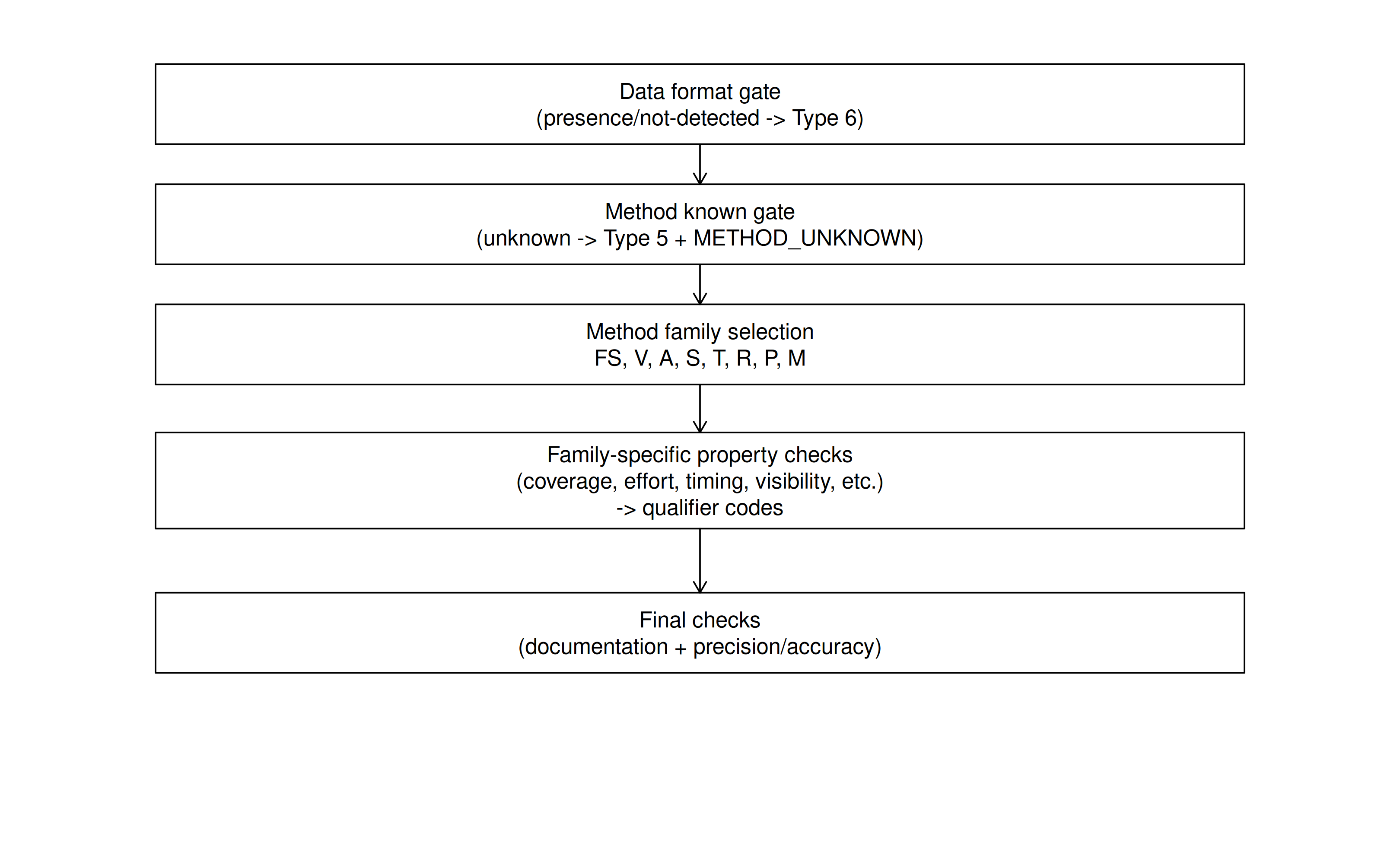
Figure 3.1: Overview of the property-first gates and method-family checks in the updated guidance.
3.2 What is updated relative to the table-only guidance
| Gap in the current table-only guidance | Update in this guidance |
|---|---|
| Methods not explicitly represented (e.g., hydroacoustic sonar) | Explicit method-family coverage and definitions, with conservative eligibility rules aligned to Hyatt (1997) |
| Ambiguous handling of breaches/bypass, coverage gaps, and infilling | Explicit qualifier codes (e.g., BREACH_BYPASS, RUN_COVERAGE, UPTIME, INFILL_METHOD) plus final documentation enforcement |
| Timing relative to expected run timing not made explicit | Timing and visibility checks within method families where these factors control comparability |
| Combined-method estimates treated as a single opaque category | Conservative approach for combined-method workflows: record components and do not conceal the weakest component |
| Calibration/historical revisions not communicated to data users | Recommend calibration metadata and revision history as part of the record (rather than inventing new public Types) |
| Precision/accuracy criteria hard to apply without uncertainty metadata | Final precision/accuracy check plus recommendation to capture quantitative uncertainty (CV/SE) when available |
| Documentation expectations not enforceable as part of a repeatable workflow | A single, published guidance implementation that produces explicit reasons for conservative classification |
3.3 Minimum evidence expectations by Type
The guidance is intended to help data providers record enough information that estimate Types can be interpreted consistently by downstream users. Table 3.2 summarizes practical minimum evidence expectations and common conservative qualifiers.
| Candidate Type | Minimum evidence for interpretation | Common qualifiers when evidence is missing |
|---|---|---|
| Type 1 (census/near-census) | Method explicitly identified; evidence that missed fish are negligible or well constrained (e.g., full coverage/uptime, bypass/breach context handled); documentation sufficient for independent review. | RUN_COVERAGE, UPTIME, BREACH_BYPASS, DOC |
| Type 2 (absolute abundance estimate) | Method explicitly identified; estimation pathway documented; quantitative uncertainty (CV/SE) recorded when available; documentation sufficient for independent review. | PRECISION_ACCURACY, DOC, METHOD_UNKNOWN |
| Type 3 (high-resolution index) | Method explicitly identified; survey effort and reach/coverage recorded; timing brackets the run window or is otherwise justified; visibility constraints documented. | VISITS, TIMING, VISIBILITY, REACH_COVERAGE, DOC |
| Type 4 (medium-resolution index) | Method explicitly identified; at least minimal effort/coverage recorded; timing/visibility constraints explicitly recorded (Type 4 is sensitive to these qualifiers). | VISITS, TIMING, VISIBILITY, DOC |
| Type 5 (low evidence / method unknown) | Method unknown or documentation insufficient for stronger inference; record method-unknown and other qualifiers so downstream users can interpret conservatively. | METHOD_UNKNOWN, DOC |
| Type 6 (presence/not-detected) | Non-numeric record (+/–); species identification credible; record observation basis and date context. | (context-dependent) |
3.4 Illustrative outcomes (hypothetical examples)
The scenarios below are hypothetical examples intended to illustrate representative outcomes from the key.
| Scenario | Key conditions | Outcome |
|---|---|---|
| Fixed site, constrained opening | Full coverage, QA review, documentation | Type 1 (no qualifiers) |
| Fixed site with bypass risk | Bypass not monitored or breach severity unknown | Type 2 + BREACH_BYPASS |
| Hydroacoustic sonar, fully documented | Classification documented, within spec, uptime sufficient, documentation present | Type 2 (no qualifiers) |
| Hydroacoustic sonar, partial coverage | Partial cross-section coverage or outages | Type 3 + XSEC_COVERAGE and/or UPTIME |
| Visual ground/snorkel, high-effort program | >=5 visits, reach coverage adequate, timing brackets peak | Type 2 (AUC pathway) or Type 3 (index pathway) |
| Visual ground/snorkel, sparse visits | 1–2 visits or visits miss the run window | Type 4 + VISITS and/or TIMING |
| Presence or not-detected | Non-numeric data format | Type 6 |